In modern manufacturing, precision, consistency, and productivity are essential for producing high-quality components. Industries such as automotive, aerospace, heavy engineering, and industrial machinery require components featuring precise slots, keyways, splines, and internal profiles. Broaching machines serve as a vital manufacturing solution, enabling the achievement of these requirements with excellent dimensional accuracy and a smooth surface finish.
At Mechocean Machines India Pvt. Ltd., understanding the right machining technology is an important step toward improving production efficiency and component quality. Whether you manufacture automotive parts, gears, or precision engineering components, learning about broaching machines can help you make better equipment decisions.
In this blog, we will explore the types of broaching machines, their working operations, common broaches, applications, and major advantages for industrial manufacturing.
What Is a Broaching Machine?
A broaching machine is an industrial machine tool that removes material from a workpiece using a specially designed cutting tool called a broach. The broach contains a series of cutting teeth arranged in increasing heights. Each tooth removes a small amount of material as the tool moves across or through the workpiece.
Unlike many conventional machining processes, broaching can complete a complex profile in a single continuous pass. This makes it especially useful for applications that require consistent dimensions and repeatable results in large production batches.
Broaching machines are commonly used to produce keyways, splines, square holes, internal grooves, and other specialised shapes. The choice of machine depends on the component design, material, production volume, and required accuracy.
Also Read: What is the Work of an SPM Machine? – A Detailed Review
How Does a Broaching Machine Work?
The broaching process is based on the controlled movement of a cutting tool through or across a component. Before starting the operation, the workpiece is positioned and secured in the machine fixture.
The broach is then moved by a pulling or pushing mechanism, depending on the machine design. As the tool passes through the material, its successive teeth remove small amounts of metal until the required shape and size are achieved.
A typical broaching machine operation involves the following steps:
- Workpiece preparation: The component is inspected, positioned, and clamped securely.
- Tool selection: A suitable broach is selected according to the required profile, material, and dimensions.
- Machine setup: The tool, fixture, stroke length, and operating parameters are checked.
- Cutting operation: The broach moves through or across the workpiece, removing material progressively.
- Finishing and inspection: The finished component is checked for dimensional accuracy, surface quality, and profile consistency.
Proper lubrication, tool maintenance, and correct machine settings help improve cutting performance and extend tool life.
Types of Broaching Machines
Different manufacturing requirements call for different machine configurations. Understanding the major types of broaching machines helps manufacturers select a suitable solution for their production needs.
1. Horizontal Broaching Machine
A horizontal broaching machine has a horizontal tool movement arrangement. It is widely used for applications that require a longer cutting stroke, particularly when working with internal profiles or components that can be supported conveniently along the machine bed.
These machines are suitable for manufacturing keyways, splines, and other precision features. Their layout can also make tool loading and workpiece positioning convenient for specific production setups.
2. Vertical Broaching Machine
A vertical broaching machine uses an upright arrangement in which the tool moves vertically during cutting. Depending on the design, the machine may operate through a push-down or pull-up mechanism.
A vertical broaching machine diagram generally shows the vertical frame, broach, drive or hydraulic system, workholding fixture, workpiece, and tool travel direction. These components work together to maintain controlled tool movement and stable cutting conditions.
Vertical machines are often selected where floor-space utilisation, accessibility, and production-line integration are important. They can be suitable for internal broaching and, in appropriate configurations, external broaching applications.
3. Surface Broaching Machine
Surface broaching machines are designed to remove material from the external surface of a workpiece. They are used to create flat surfaces, contours, grooves, and other external profiles.
These machines are particularly useful when manufacturers need repeatable surface features across a large number of components.
4. Continuous Broaching Machine
Continuous broaching machines are designed for high-volume production. Workpieces move through a production arrangement while the broaching process takes place in a controlled sequence.
They are commonly considered for applications where production speed, repeatability, and integration with automated manufacturing systems are important.
5. Rotary Broaching Machine
Rotary broaching is a specialised process used to produce polygonal profiles, such as hexagonal or square shapes, in suitable components. The cutting tool and machine arrangement allow the required profile to be formed through a controlled relative movement.
Rotary broaching is useful for certain precision features, although it differs from conventional linear broaching machines in tool motion and application.
Understanding a Broaching Machine Diagram
A broaching machine diagram helps operators and buyers understand how the machine components are arranged and how cutting takes place. Although the layout varies between machine models, a typical diagram may include the following parts:
- Machine frame: Supports the machine assembly and withstands operating forces.
- Drive system: Provides the required movement and cutting force.
- Broach tool: Contains progressive cutting teeth that form the required profile.
- Workholding fixture: Holds the component in the correct position.
- Guide system: Helps maintain proper tool alignment during movement.
- Hydraulic or mechanical system: Controls the tool stroke, depending on the machine design.
- Control panel: Allows the operator to manage machine settings and operating functions.
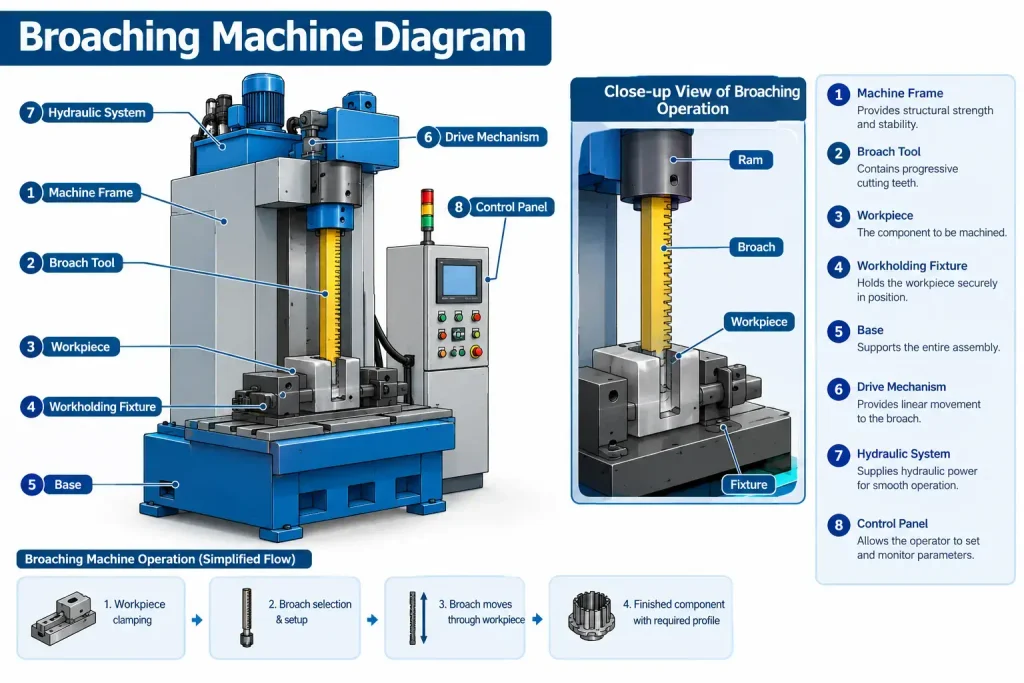
In a vertical broaching machine diagram, these elements are usually arranged around an upright frame, with the tool moving vertically through its working stroke.
Studying the diagram before machine selection can help manufacturers understand the available working space, loading arrangement, maintenance access, and suitability for a particular component.
Types of Broaches Used in Manufacturing
The tool used in broaching has a direct impact on the finished component. Different types of broaches are designed for specific shapes and machining requirements.
Internal Broach
Internal broaches are used to machine features inside a workpiece, including keyways, splines, square holes, and other internal profiles. A starting hole or suitable pre-machined opening is generally required.
Surface Broach
Surface broaches remove material from the external face of a component. They are used to produce flat surfaces, grooves, and defined contours.
Keyway Broach
Keyway broaches create accurately sized slots that allow keys to connect rotating components, such as shafts and hubs.
Spline Broach
Spline broaches produce multiple teeth or grooves that help transmit torque between mating components. They are widely used in automotive and mechanical power-transmission systems.
Pot Broach
Pot broaches are used for external machining of suitable components. The workpiece passes through a specially designed tool that forms the required external profile.
The appropriate broach depends on the workpiece material, profile geometry, tolerances, production volume, and available machine configuration.
Major Applications of Broaching Machines
Broaching machines are used across several industries because they can produce accurate profiles efficiently.
Automotive manufacturing: Used for machining transmission components, gear-related parts, shafts, hubs, and keyways.
Aerospace engineering: Suitable for selected precision components where complex profiles and consistent dimensions are required.
Heavy engineering: Used to manufacture machine parts, industrial drive components, and specialised metal components.
Tool and die manufacturing: Helps produce specific slots, profiles, and accurately shaped features.
General engineering: Supports the production of splined shafts, couplings, bushings, and other mechanical components.
The exact application depends on component geometry, material properties, tool design, and the machine’s rated capacity.
Advantages of Broaching Machines
Broaching offers several benefits for manufacturers seeking reliable production performance.
1. High Production Efficiency
A broach can generate a complete profile in one pass, reducing the need for multiple machining operations. This can shorten cycle times for suitable components.
2. Consistent Dimensional Accuracy
With proper tooling, fixturing, and machine settings, broaching can deliver repeatable dimensions across production batches.
3. Excellent Surface Finish
Broaching can provide a good surface finish on suitable materials and geometries, reducing the need for additional finishing processes.
4. Reduced Manual Intervention
Once the machine is correctly set up, the cutting operation follows a controlled sequence. This helps reduce repetitive manual work and supports consistent output.
5. Suitable for Mass Production
Broaching is particularly effective for repetitive manufacturing because a dedicated broach can produce the same profile across many workpieces.
6. Lower Cost Per Component
Although specialised broaching tools may involve a significant initial investment, high-volume production can reduce the cost per component by improving throughput and limiting secondary operations.
How to Choose the Right Broaching Machine
Selecting a broaching machine requires more than comparing machine prices. Manufacturers should consider the following factors before making a purchase:
- Component design: Identify whether the requirement involves internal slots, splines, flat surfaces, or external profiles.
- Production volume: Match the machine configuration to expected daily or annual output.
- Material type: Consider the hardness, machinability, and dimensions of the workpiece.
- Required accuracy: Confirm the dimensional tolerances and surface finish needed for the application.
- Tooling requirements: Check broach availability, tool life, regrinding options, and replacement costs.
- Machine capacity: Evaluate stroke length, cutting force, working area, and workpiece size.
- Maintenance and support: Consider service availability, spare parts, operator training, and long-term operating costs.
Discussing these requirements with an experienced machine supplier can help avoid an unsuitable investment and improve production planning.
Conclusion
Broaching machines are an excellent solution for manufacturers who require precise profiles, consistent quality, and efficient production. From horizontal and vertical machines to specialized surface and continuous broaching systems, each type of machine caters to specific manufacturing needs. Selecting the right broach and understanding the overall operation of the broaching machine are both crucial for achieving reliable results.
Mechocean Machines India Pvt. Ltd. can be considered as a business contact point for manufacturers exploring industrial machining solutions. Before finalising a machine, evaluate your component specifications, production targets, tooling requirements, and technical support needs to identify the most suitable option for your facility.
If your manufacturing process involves keyways, splines, internal profiles, or other specialised features, understanding broaching technology is a practical first step toward improving machining efficiency and component consistency.