Choosing the right press machine is one of the most important decisions for any manufacturing industry. Whether you are involved in metal fabrication, automotive manufacturing, aerospace, appliance production, or heavy engineering, selecting the appropriate press directly impacts productivity, product quality, and operating costs.
Among the most commonly used machines are the hydraulic press and the mechanical press machine. Although both perform pressing, punching, bending, stamping, and forming operations, their working principles, performance, speed, and applications are quite different.
In this blog, we’ll provide a detailed comparison of Hydraulic Press vs Mechanical Press, explain their working principles, advantages, limitations, and help you determine which machine best suits your manufacturing requirements.
What Is a Hydraulic Press?
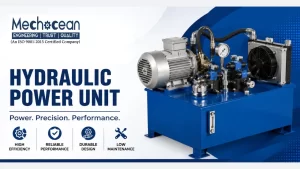
A hydraulic press is a machine that generates force using hydraulic fluid pressure based on Pascal’s Law. It uses hydraulic cylinders, pumps, valves, and hydraulic oil to create controlled and powerful pressing force.
Unlike conventional presses, hydraulic presses can deliver full tonnage throughout the entire stroke, making them suitable for applications requiring high pressure and precision. Modern hydraulic presses are widely used in automotive, metal forming, forging, deep drawing, powder compaction, plastic molding, and heavy fabrication industries.
Also Read: Hydraulic Press vs Pneumatic Press: What’s the Difference?
What Is a Mechanical Press Machine?
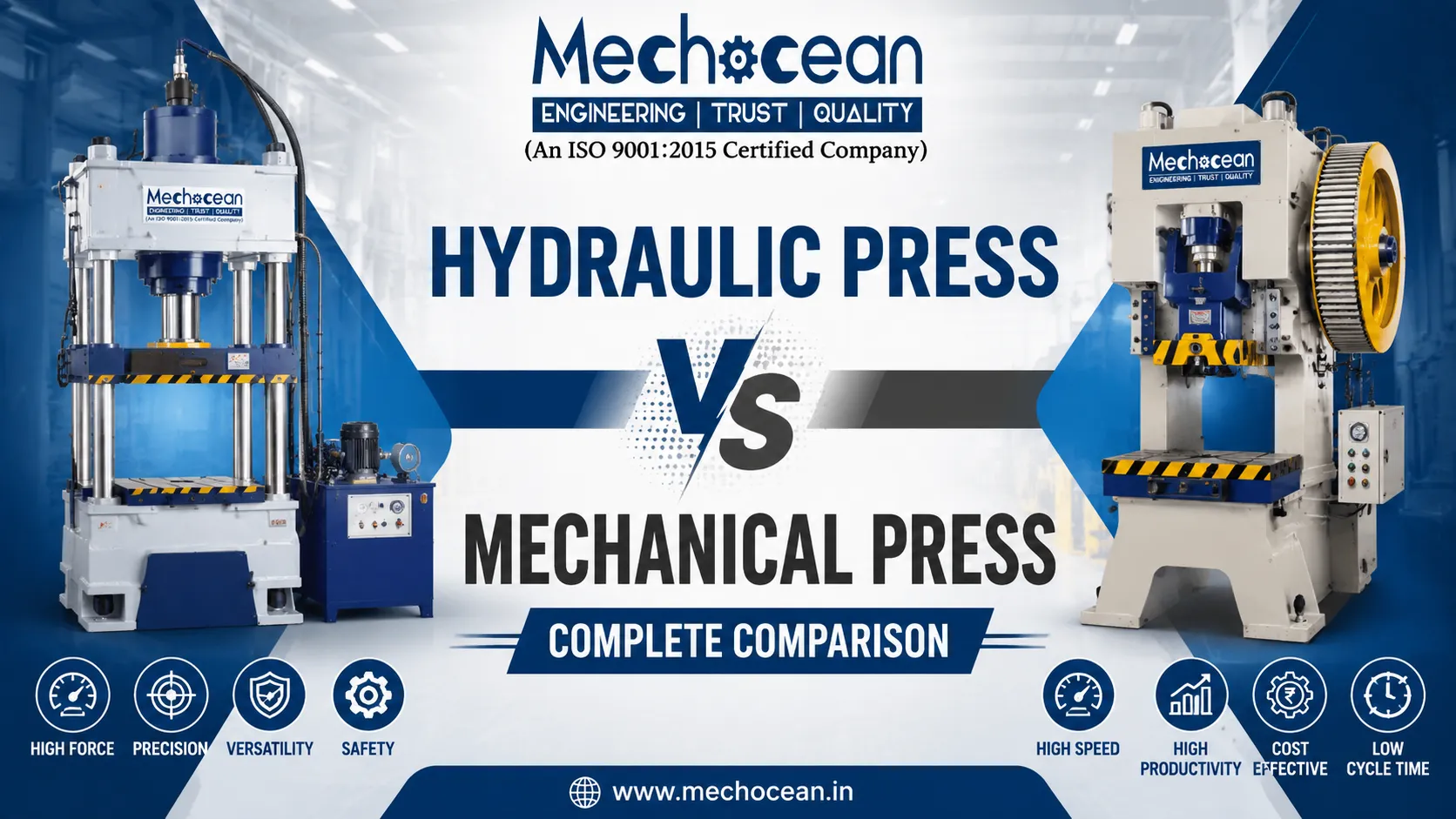
A mechanical press machine generates pressing force through a flywheel, crankshaft, gears, connecting rods, and mechanical linkages powered by an electric motor. The rotating flywheel stores kinetic energy and transfers it to the ram during each press cycle. Maximum force is usually available only near the bottom of the stroke.
Because of its high operating speed, a mechanical press is commonly used for repetitive production processes where productivity is the primary objective. Industries manufacturing sheet metal components often rely on mechanical stamping press systems for mass production.
Hydraulic Press vs Mechanical Press: Working Principle
The biggest difference between these two machines lies in how they generate force. A hydraulic press converts hydraulic fluid pressure into mechanical force using cylinders. The pressure remains consistent throughout the stroke, allowing precise control over speed, force, and movement.
A mechanics press operates through rotating mechanical components. Energy stored in the flywheel drives the ram downward to perform pressing operations. Since force depends on the flywheel’s momentum, maximum tonnage is available only at a specific point in the stroke. This difference significantly influences machine performance and application suitability.
Hydraulic Press vs Mechanical Press: Detailed Comparison
1. Force Generation
A hydraulic press provides full pressing force during the entire stroke, making it ideal for deep drawing, forming, compression, and heavy-duty operations. A mechanical press machine develops peak force only near the bottom dead center, making it better suited for blanking, punching, and high-speed stamping.
2. Precision and Control
Hydraulic presses offer exceptional control over pressure, speed, stroke length, and dwell time. Operators can easily adjust machine parameters according to different production requirements. Mechanical presses generally have fixed stroke characteristics and limited flexibility. For manufacturers requiring consistent quality across multiple product designs, hydraulic presses provide greater operational control.
3. Production Speed
When comparing production speed, mechanical presses have a clear advantage. A mechanical stamping press can complete hundreds of strokes per minute, making it highly suitable for continuous mass production. Hydraulic presses operate at slower speeds but provide significantly higher accuracy and forming capability.
4. Versatility
Hydraulic presses are extremely versatile.
A single machine can perform:
- Metal forming
- Deep drawing
- Bending
- Straightening
- Coining
- Compression molding
- Powder compaction
- Assembly operations
Mechanical presses are generally optimized for repetitive stamping and punching applications.
5. Maintenance
Hydraulic presses contain pumps, cylinders, hoses, valves, and hydraulic oil that require periodic inspection and maintenance. Mechanical presses include gears, bearings, flywheels, clutches, brakes, and crankshafts that require lubrication and alignment. Both machines require preventive maintenance, but hydraulic systems are generally easier to diagnose due to modern electronic monitoring.
6. Energy Efficiency
Modern servo-controlled hydraulic presses consume energy only when force is required. Mechanical presses continuously rotate the flywheel, resulting in higher energy consumption during idle operation. Today’s hydraulic systems are designed with energy-efficient pumps and variable-speed drives that significantly reduce operating costs.
7. Safety
Hydraulic presses incorporate advanced safety features including overload protection, programmable controls, pressure monitoring, emergency stop systems, and safety interlocks.
Mechanical presses also offer safety devices, but hydraulic presses generally provide better overload protection because pressure can be electronically controlled.
Applications of Hydraulic Press
Hydraulic presses are used across numerous industries because of their flexibility and high pressing force.
Common applications include:
- Automotive component manufacturing
- Aerospace components
- Sheet metal forming
- Powder metallurgy
- Deep drawing
- Metal embossing
- Rubber molding
- Plastic molding
- Forging
- Heavy fabrication
- Composite material forming
- Industrial assembly operations
Applications of Mechanical Press
A mechanical press machine is widely used where speed and repetitive production are the primary requirements.
Typical applications include:
- Sheet metal stamping
- Electrical component manufacturing
- Appliance production
- Coin minting
- Blanking
- Punching
- Piercing
- Progressive die operations
- High-volume production lines
- Automotive sheet metal components
Industries requiring fast and continuous production often choose a hydraulic stamping press for controlled forming applications, while a mechanical stamping press is preferred for repetitive, high-speed stamping jobs.
Hydraulic Stamping Press vs Mechanical Stamping Press
A hydraulic stamping press offers superior flexibility because pressure, speed, and stroke can be adjusted according to the workpiece. It is particularly suitable for thicker materials, complex geometries, and applications requiring controlled deformation. A mechanical stamping press, on the other hand, excels in producing identical parts at very high speeds. It is commonly used in industries where millions of components are manufactured annually using progressive dies. The choice depends on whether precision or production speed is the primary objective.
Which Press Should You Choose?
The right press depends entirely on your manufacturing process.
Choose a Hydraulic Press if you require:
- High pressing force
- Deep drawing
- Metal forming
- Adjustable pressure
- Variable stroke length
- Heavy-duty industrial applications
- Better process flexibility
Choose a Mechanical Press Machine if you require:
- High-speed production
- Repetitive stamping
- Large production volumes
- Progressive die applications
- Faster cycle times
- Lower cost per part in mass production
Understanding your production goals is the key to making the right investment.
Why Choose Mechocean Machines India Pvt. Ltd.?
Mechocean Machines India Pvt. Ltd. is a trusted manufacturer of advanced hydraulic machinery designed for modern industrial applications.
Our hydraulic presses are engineered using premium-quality components, precision hydraulic systems, and advanced automation to deliver outstanding performance, reliability, and long service life.
We offer customized hydraulic press solutions for automotive, aerospace, heavy engineering, defense, railway, fabrication, electrical, and manufacturing industries.
From machine design and manufacturing to installation, commissioning, operator training, and after-sales support, our experienced engineering team ensures complete customer satisfaction.
Every machine is built to maximize productivity, improve operational efficiency, and reduce long-term maintenance costs.
Conclusion
When comparing Hydraulic Press vs Mechanical Press, there is no universal winner. Both machines are designed for different manufacturing objectives. A hydraulic press offers unmatched flexibility, precision, adjustable force, and versatility, making it ideal for complex forming operations and heavy-duty industrial applications.
A mechanical press machine delivers exceptional production speed and efficiency, making it the preferred choice for repetitive stamping and high-volume manufacturing. Before making an investment, manufacturers should carefully evaluate production volume, material type, accuracy requirements, operational costs, and future expansion plans.
If you’re looking for reliable, high-performance hydraulic press solutions tailored to your industrial requirements, Mechocean Machines India Pvt. Ltd. provides customized machines engineered for superior productivity, durability, and long-term value.
Frequently Asked Questions (FAQs)
1. Which is better: a hydraulic press or a mechanical press?
It depends on your application. Hydraulic presses are ideal for precision, heavy forming, and flexibility, while mechanical presses are better for high-speed, repetitive production.
2. What is a mechanical press machine used for?
A mechanical press machine is commonly used for punching, blanking, stamping, piercing, and mass production of sheet metal components.
3. What is a hydraulic stamping press?
A hydraulic stamping press uses hydraulic pressure to perform stamping operations with adjustable force and excellent precision, making it suitable for complex forming applications.
4. What industries use hydraulic presses?
Hydraulic presses are widely used in automotive, aerospace, railway, heavy engineering, defense, fabrication, appliance manufacturing, and metal forming industries.
5. Why choose Mechocean Machines India Pvt. Ltd.?
Mechocean Machines India Pvt. Ltd. offers customized, high-performance hydraulic press solutions with advanced engineering, reliable performance, excellent build quality, and comprehensive after-sales support for diverse industrial applications.