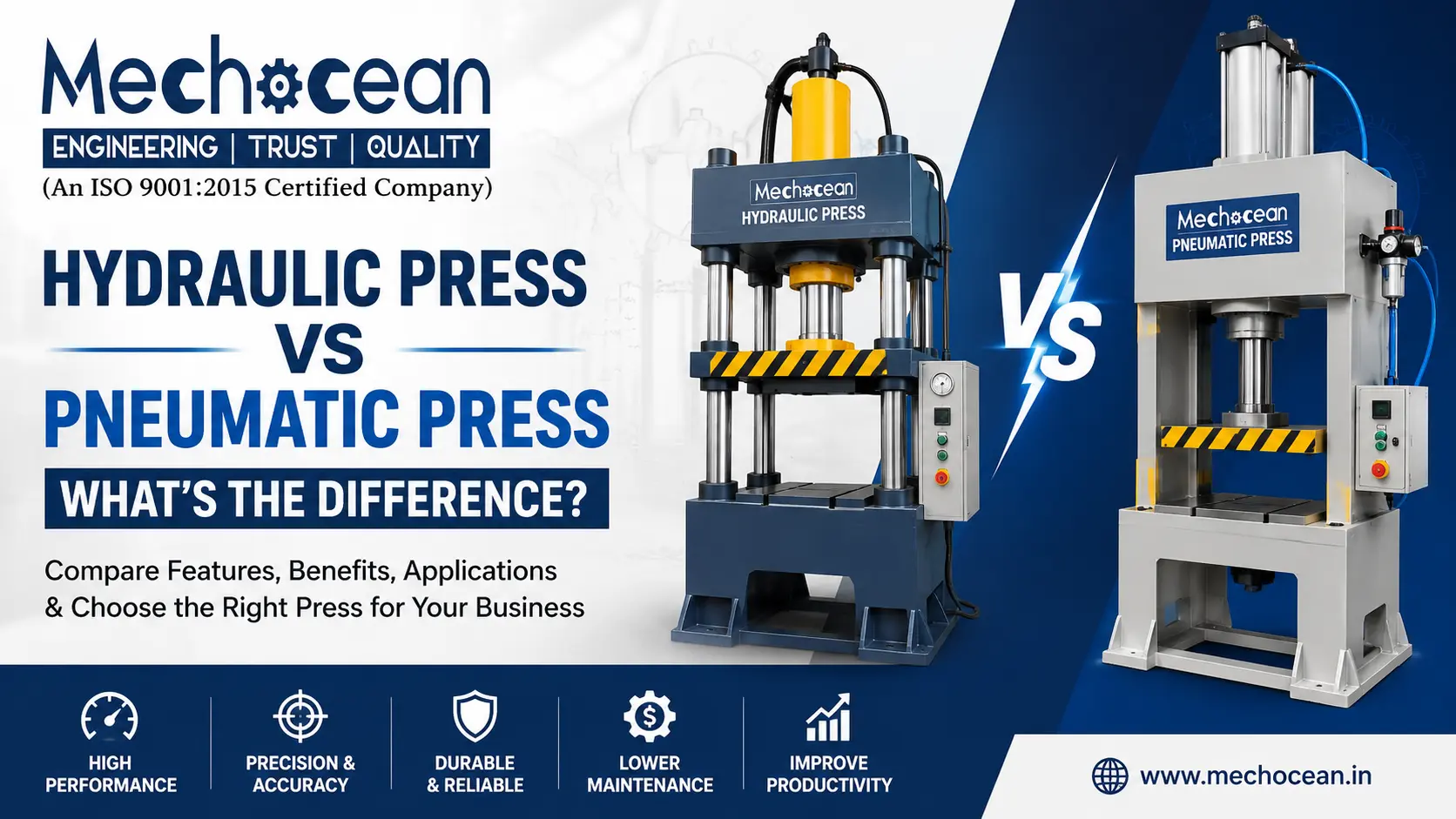
Choosing the right press machine is one of the most important decisions for any manufacturing facility. Whether you work in the automotive, aerospace, sheet metal, fabrication, appliance, or engineering industry, selecting the appropriate press directly impacts production speed, product quality, operating costs, and overall efficiency.
Among the most commonly used industrial presses are hydraulic presses and pneumatic presses. While both machines are designed to apply force for forming, punching, pressing, bending, assembling, and shaping materials, they operate using entirely different technologies and offer unique advantages.
If you’re wondering Hydraulic Press vs Pneumatic Press: What’s the Difference?, this comprehensive guide by Mechocean Machines India Pvt. Ltd. explains how both machines work, their advantages, applications, limitations, and which option is best suited for your industrial requirements.
What is a Hydraulic Press?
A Hydraulic Press is a machine that generates force using hydraulic fluid pressure. Based on Pascal’s Law, hydraulic presses multiply force through pressurized oil flowing inside hydraulic cylinders.
These machines are capable of generating extremely high pressure, making them ideal for heavy-duty industrial operations such as metal forming, forging, deep drawing, straightening, compression molding, and assembly.
Hydraulic presses are widely used because they provide consistent pressure throughout the entire stroke while offering excellent control over speed and force.
What is a Pneumatic Press Machine?
A Pneumatic Press Machine uses compressed air instead of hydraulic oil to generate pressing force. Compressed air enters the pneumatic cylinder and moves the piston to perform pressing operations. Since air compresses much faster than hydraulic fluid, pneumatic presses operate at higher speeds and are commonly used for light- to medium-duty production tasks. Industries prefer pneumatic presses for repetitive manufacturing operations where speed is more important than extremely high force.
Pneumatic Press vs Hydraulic Press
When comparing Pneumatic Press vs Hydraulic Press, the biggest difference lies in the source of power. A hydraulic press uses pressurized hydraulic oil to generate massive force, whereas a pneumatic press relies on compressed air.
Hydraulic presses offer higher pressing capacity, greater precision, and better control, making them suitable for heavy industrial applications. Pneumatic presses, on the other hand, are faster, cleaner, and more economical for light assembly and stamping operations.
Both machines serve different production requirements, so selecting the right one depends on the type of application, required pressure, cycle time, and production volume.
Hydraulic Press vs Pneumatic Press: Key Differences
| Feature | Hydraulic Press | Pneumatic Press |
|---|---|---|
| Power Source | Hydraulic Oil | Compressed Air |
| Pressing Force | Very High | Moderate |
| Speed | Moderate | High |
| Accuracy | Excellent | Good |
| Stroke Control | Precise | Limited |
| Maintenance | Moderate | Low |
| Operating Cost | Medium | Low |
| Best For | Heavy-duty operations | High-speed repetitive jobs |
How Much Pressure Does a Hydraulic Press Have?
One of the most common questions asked by buyers is “How much pressure does a hydraulic press have?” The answer depends on the machine’s design and application.
Industrial hydraulic presses are available in capacities ranging from:
- 10 Ton
- 20 Ton
- 50 Ton
- 100 Ton
- 200 Ton
- 500 Ton
- 1000 Ton
- 2000 Ton and above
Heavy industrial hydraulic presses used in automobile manufacturing, forging, aerospace, and heavy engineering can generate several thousand tons of pressing force. Unlike pneumatic presses, hydraulic presses maintain constant pressure throughout the pressing cycle, making them ideal for precision manufacturing.
What is a Pneumatic Shop Press?
A Pneumatic Shop Press is a workshop press that combines compressed air with mechanical assistance to simplify pressing operations.
These presses are commonly found in:
- Automobile workshops
- Repair centers
- Maintenance facilities
- Small fabrication shops
- Machine repair units
Pneumatic shop presses are ideal for removing bearings, installing bushings, pressing gears, straightening components, and performing light assembly work. Because of their simple operation and affordable cost, they are popular among maintenance professionals.
Advantages of Hydraulic Press
Hydraulic presses continue to dominate heavy manufacturing due to several important advantages.
High Pressing Capacity
Hydraulic systems generate enormous force suitable for thick metal forming and heavy industrial applications.
Excellent Precision
Pressure can be controlled accurately throughout the stroke, ensuring uniform product quality.
Smooth Operation
Hydraulic presses operate with minimal vibration and consistent force distribution.
Versatile Applications
They can perform bending, punching, embossing, forging, compression molding, deep drawing, and assembly using a single machine.
Longer Service Life
With proper maintenance, hydraulic presses provide reliable performance for many years.
Advantages of Pneumatic Press Machine
Although pneumatic presses produce less force, they offer several practical benefits.
Faster Production
Compressed air enables rapid cycle times, making pneumatic presses ideal for mass production.
Clean Operation
Since they use air instead of oil, pneumatic presses eliminate the risk of hydraulic oil leakage.
Lower Initial Investment
Pneumatic systems are generally more economical than hydraulic presses.
Simple Maintenance
Fewer components make servicing easier and reduce maintenance costs.
Energy Efficient for Light Applications
They consume less energy during light-duty manufacturing operations.
Applications of Hydraulic Press
Hydraulic presses are extensively used in:
- Automobile manufacturing
- Aerospace industry
- Heavy engineering
- Sheet metal fabrication
- Steel plants
- Railways
- Electrical equipment manufacturing
- Defense sector
- Forging industries
- Plastic molding
- Rubber molding
- Industrial assembly
Applications of Pneumatic Press
Pneumatic press machines are commonly used for:
- Electronic assembly
- Light stamping
- Small component manufacturing
- Plastic assembly
- Packaging industries
- Medical device manufacturing
- Food processing equipment
- Laboratory applications
- Textile machinery
- Small fabrication workshops
Hydraulic Press vs Hydraulic Press – Which Hydraulic Press is Right?
Many buyers search for Hydraulic Press vs Hydraulic Press because they want to compare different hydraulic press models rather than hydraulic and pneumatic machines.
The right hydraulic press depends on several factors, including:
- Required tonnage
- Material type
- Production volume
- Automation requirements
- Stroke length
- Working pressure
- Available installation space
Modern hydraulic presses are available as C-frame presses, H-frame presses, four-column presses, workshop presses, deep drawing presses, and customized special-purpose machines. Selecting the correct configuration ensures better productivity, improved accuracy, and lower operating costs.
Which Press Should You Choose?
There is no single answer because every manufacturing process has different requirements.
Choose a Hydraulic Press if your application requires:
- Heavy forming
- Metal forging
- High-pressure operations
- Deep drawing
- Precision pressing
- Thick material processing
Choose a Pneumatic Press Machine if your production requires:
- Fast cycle times
- Light assembly
- Small component manufacturing
- Low maintenance
- Clean working environment
- Repetitive operations
Understanding your production goals will help you select the most suitable press for long-term efficiency.
Why Choose Mechocean Machines India Pvt. Ltd.?
Mechocean Machines India Pvt. Ltd. is a trusted manufacturer of advanced hydraulic press solutions designed to meet the evolving needs of modern industries. Our machines are engineered using premium-quality components, precision hydraulic systems, and robust construction to ensure superior performance, durability, and safety.
From standard workshop presses to fully customized hydraulic press systems, we provide complete solutions tailored to your production requirements. Our experienced team supports customers from design and manufacturing to installation and after-sales service, ensuring maximum operational efficiency and long-term reliability.
Whether you need a compact workshop press or a heavy-duty industrial hydraulic press, Mechocean Machines India Pvt. Ltd. delivers innovative, high-performance solutions that help businesses improve productivity and reduce operating costs.
Conclusion
Understanding Hydraulic Press vs Pneumatic Press: What’s the Difference? is essential before investing in industrial machinery. While hydraulic presses excel in high-force, precision-based applications, pneumatic presses are the preferred choice for fast, repetitive, and light-duty manufacturing tasks.
When evaluating Pneumatic Press vs Hydraulic Press, factors such as required tonnage, production speed, maintenance, and application type should guide your decision. If your operations demand exceptional force and consistent performance, a hydraulic press is the ideal solution. For lighter applications requiring speed and simplicity, a pneumatic press machine offers an efficient alternative.
At Mechocean Machines India Pvt. Ltd., we are committed to providing high-quality hydraulic press solutions that deliver outstanding performance, reliability, and value for industries across India and international markets.