Hydraulic cylinders are super important for modern machinery. They turn hydraulic energy into straight-line force, letting machines lift, push, pull, and move stuff accurately and easily. Whether it’s construction gear, factory equipment, marine setups, or farm machines, these cylinders get used all over the place and make tons of tasks possible.
Understanding the different types of hydraulic cylinder designs and configurations can help businesses select the right solution for their operational requirements. In this guide, we will explore hydraulic cylinder types, their configurations, and the industries where they are commonly used.
What Is a Hydraulic Cylinder?
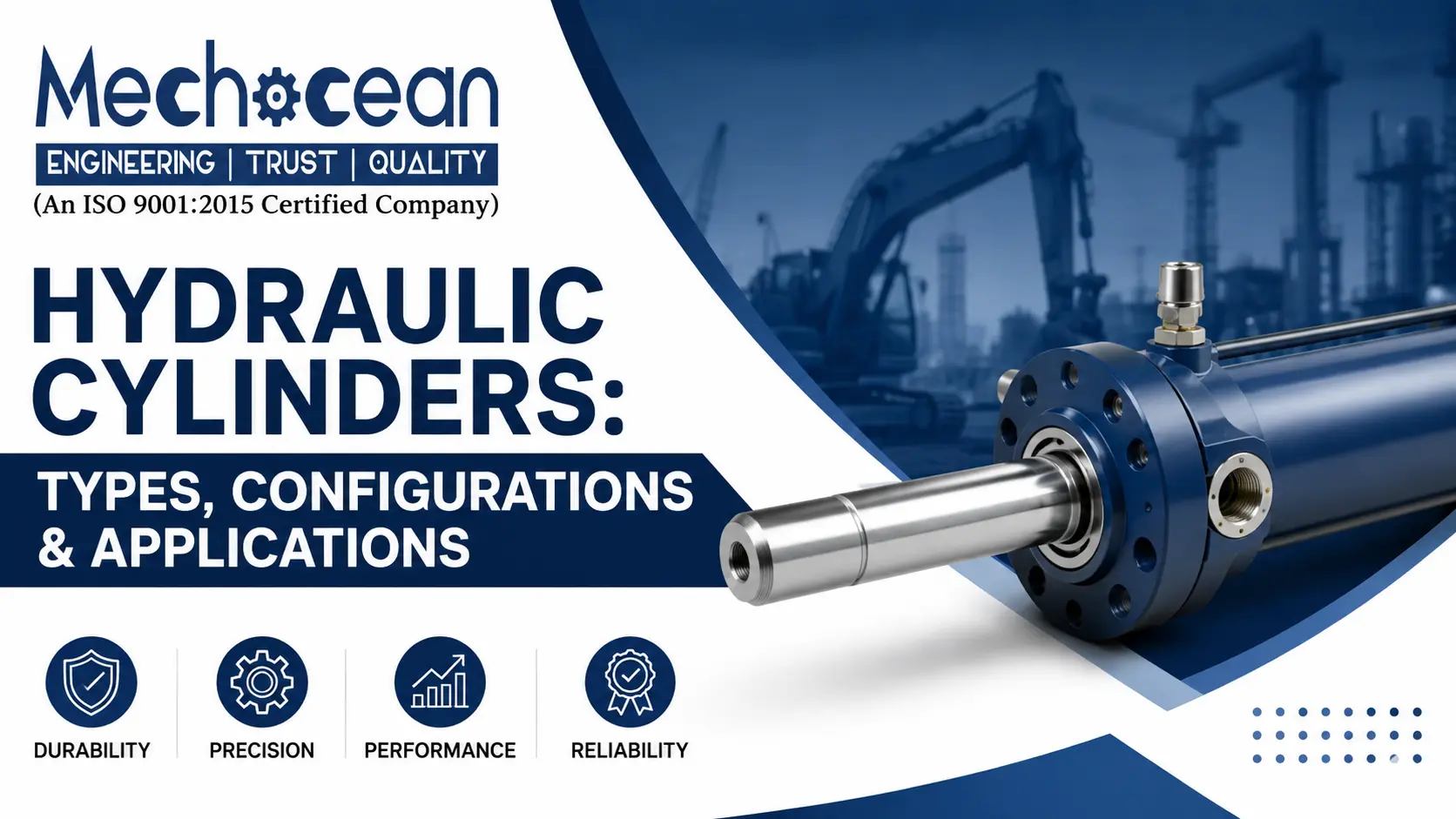
A hydraulic cylinder is a mechanical actuator powered by pressurized hydraulic fluid. It consists of a cylinder barrel, piston, piston rod, seals, and end caps. When hydraulic fluid enters the cylinder, pressure is generated against the piston, causing it to move in a linear direction and produce force.
Hydraulic cylinders are preferred in industrial applications because they provide high force output, smooth motion control, durability, and reliable performance even under demanding operating conditions.
Also Read: What Is a Hydraulic Cylinder? How Does It Work?
Why Hydraulic Cylinders Are Important
Hydraulic cylinders offer several advantages that make them indispensable in industrial operations:
- High force generation capability
- Precise linear movement
- Smooth and controlled operation
- Ability to handle heavy loads
- Long service life with proper maintenance
- Suitable for harsh environments
These benefits make hydraulic cylinders ideal for applications where powerful and reliable motion control is required.
Types of Hydraulic Cylinder
There are several types of hydraulic cylinder designs available, each developed for specific operational requirements. Selecting the correct cylinder type can significantly improve machine performance and efficiency.
1. Single-Acting Hydraulic Cylinder
A single-acting hydraulic cylinder uses hydraulic pressure in only one direction. The return movement is usually achieved through gravity, springs, or external force.
Key Features:
- Simple design
- Lower maintenance requirements
- Cost-effective operation
- Suitable for lifting and pushing applications
Common Applications:
- Hydraulic jacks
- Material handling equipment
- Agricultural machinery
- Lifting platforms
2. Double-Acting Hydraulic Cylinder
Among the most widely used hydraulic cylinder types, double-acting cylinders use hydraulic pressure for both extension and retraction movements.
Benefits:
- Better control over movement
- Higher operational efficiency
- Suitable for continuous-duty applications
- Increased productivity
Common Applications:
- Excavators
- Industrial presses
- Construction machinery
- Manufacturing equipment
3. Telescopic Hydraulic Cylinder
A telescopic cylinder consists of multiple nested stages that extend sequentially. This design allows for a long stroke length while maintaining a compact retracted size.
Advantages:
- Extended reach
- Space-saving design
- High lifting capability
Applications:
- Dump trucks
- Cranes
- Waste management vehicles
- Heavy-duty lifting systems
4. Tie-Rod Hydraulic Cylinder
Tie-rod cylinders use threaded steel rods to secure the end caps to the cylinder barrel.
Features:
- Easy maintenance
- Modular construction
- Suitable for industrial environments
Applications:
- Manufacturing machinery
- Factory automation systems
- Production equipment
5. Welded Hydraulic Cylinder
Welded cylinders feature end caps directly welded to the barrel, resulting in a compact and robust design.
Benefits:
- High strength
- Reduced installation space
- Better resistance to external stress
Applications:
- Construction equipment
- Mobile machinery
- Agricultural equipment
Hydraulic Cylinder Configurations
In addition to understanding the various types of hydraulic cylinders, it is equally important to know their configurations. The configuration determines how the cylinder is mounted and integrated into a machine.
- Front Flange Mount- The cylinder is mounted using a flange located at the front end. This configuration is suitable for straight-line force applications and offers excellent rigidity.
- Rear Flange Mount- The mounting flange is positioned at the rear of the cylinder, making it ideal for applications where the cylinder remains fixed while the rod performs the work.
- Clevis Mount- A clevis mount allows the cylinder to pivot during operation, reducing stress on mounting points and improving alignment.
- Trunnion Mount- Trunnion-mounted cylinders provide flexibility and are commonly used in equipment requiring rotational movement around a pivot point.
- Foot Mount- Foot-mounted cylinders are secured at the base and are widely used in stationary industrial machinery.
Selecting the Right Type of Hydraulic Cylinder
Choosing the appropriate type of hydraulic cylinder depends on several operational factors:
- Load Requirements- Determine the amount of force required for the application. Heavy-duty applications often require larger bore sizes and stronger cylinder designs.
- Stroke Length- The required travel distance of the piston rod directly influences cylinder selection.
- Operating Pressure- Different applications operate under varying pressure ranges. The cylinder should be designed to safely withstand the intended pressure.
- Environmental Conditions- Factors such as dust, moisture, chemicals, and extreme temperatures should be considered when selecting seals and cylinder materials.
- Installation Space- Compact equipment may require telescopic or welded cylinder configurations to optimize available space.
Industrial Applications of Hydraulic Cylinders
Hydraulic cylinders are utilized across a wide range of industries due to their versatility and power.
Construction Industry
Construction machinery relies heavily on hydraulic cylinders for lifting, digging, and material handling tasks.
Applications include:
- Excavators
- Bulldozers
- Backhoe loaders
- Cranes
Manufacturing Industry
Hydraulic cylinders are essential for machine automation and industrial production processes.
Applications include:
- Hydraulic presses
- Injection molding machines
- Material handling systems
- Assembly line equipment
Marine Industry
Marine hydraulic systems use cylinders for steering, lifting, and cargo handling operations.
Applications include:
- Ship steering systems
- Deck machinery
- Hatch covers
- Marine cranes
Agricultural Industry
Modern farming equipment utilizes hydraulic cylinders to improve productivity and operational efficiency.
Applications include:
- Tractors
- Harvesters
- Seed drills
- Agricultural loaders
Mining Industry
Mining operations require robust hydraulic cylinders capable of performing under extreme conditions.
Applications include:
- Drilling equipment
- Excavation machinery
- Underground mining vehicles
- Material transport systems
Future Trends in Hydraulic Cylinder Technology
Technological advancements are improving hydraulic cylinder performance and reliability. Modern cylinders increasingly feature:
- Smart sensors for real-time monitoring
- Improved sealing technologies
- Corrosion-resistant materials
- Energy-efficient hydraulic systems
- Predictive maintenance capabilities
These innovations help industries reduce maintenance costs while improving productivity and equipment lifespan.
Conclusion
Hydraulic cylinders are essential components in industrial machinery, providing the force and motion required for countless applications. Understanding the different types of hydraulic cylinder designs, available configurations, and application requirements helps businesses select the most suitable solution for their operations.
Whether it is a single-acting, double-acting, telescopic, tie-rod, or welded design, each of the major types of hydraulic cylinders offers unique advantages. By choosing the right hydraulic cylinder types and maintaining them properly, industries can achieve greater efficiency, reliability, and long-term operational success.
At Mechocean Machines India Pvt. Ltd., we are committed to delivering high-quality hydraulic cylinder solutions engineered to meet the demanding requirements of modern industries.