In today’s fast-growing industrial world, efficiency and speed are very important for any manufacturing business. One of the most important systems that helps industries produce goods quickly and in large quantities is the assembly line. But many people still ask, what is an assembly line and how does it actually work?
In this complete guide by MECHOCEAN MACHINES INDIA PVT. LTD., we will explain everything — from the assembly line definition to its purpose, characteristics, and benefits in modern manufacturing.
What is an Assembly Line?
An assembly line is a manufacturing process in which a product is created step by step by passing it through different workstations. At each station, a specific task is performed until the final product is ready. In simple terms, instead of one worker making a full product, multiple workers or machines handle different parts of the process. This makes production faster and more efficient.
Assembly Line Definition
A production method where components are added to a product in a sequential manner using a series of workstations.
This method is widely used in industries like:
- Automobile manufacturing
- Electronics production
- Food processing
- Packaging industries
It has become a backbone of modern industrial production.
What Purpose Does the Assembly Line Serve?
The main purpose of an assembly line is to:
- Increase production speed
- Reduce manufacturing time
- Lower labor cost
- Maintain consistent product quality
By dividing the work into smaller tasks, each worker or machine becomes specialized in one job. This reduces errors and improves overall efficiency.
For example, in a car manufacturing plant, one station installs wheels, another fits the engine, and another handles painting. This organized flow helps produce thousands of vehicles in less time.
How Does an Assembly Line Work?
The working of an assembly line is simple and systematic:
- Raw materials are introduced at the beginning of the line
- The product moves from one station to another
- Each station performs a specific task
- The process continues step by step
- Final product comes out at the end
This continuous movement ensures that there is no delay in production.
Assembly Line Characteristics
To understand this system better, let’s look at the key assembly line characteristics:
- Sequential Process- Each task is completed in a fixed order. The product moves step by step from start to finish.
- Division of Work- Work is divided into small, simple tasks. Each worker or machine performs only one job.
- Continuous Flow- Production does not stop. The line keeps moving, ensuring smooth workflow.
- High Efficiency– Since tasks are repeated, workers become skilled and faster, increasing productivity.
- Standardization- All products are made in the same way, ensuring uniform quality.
- Time Saving- Production time is reduced significantly compared to traditional methods.
Types of Assembly Lines
There are different types of assembly lines used in industries:
- Manual Assembly Line- Work is done mainly by human workers. Suitable for small-scale industries.
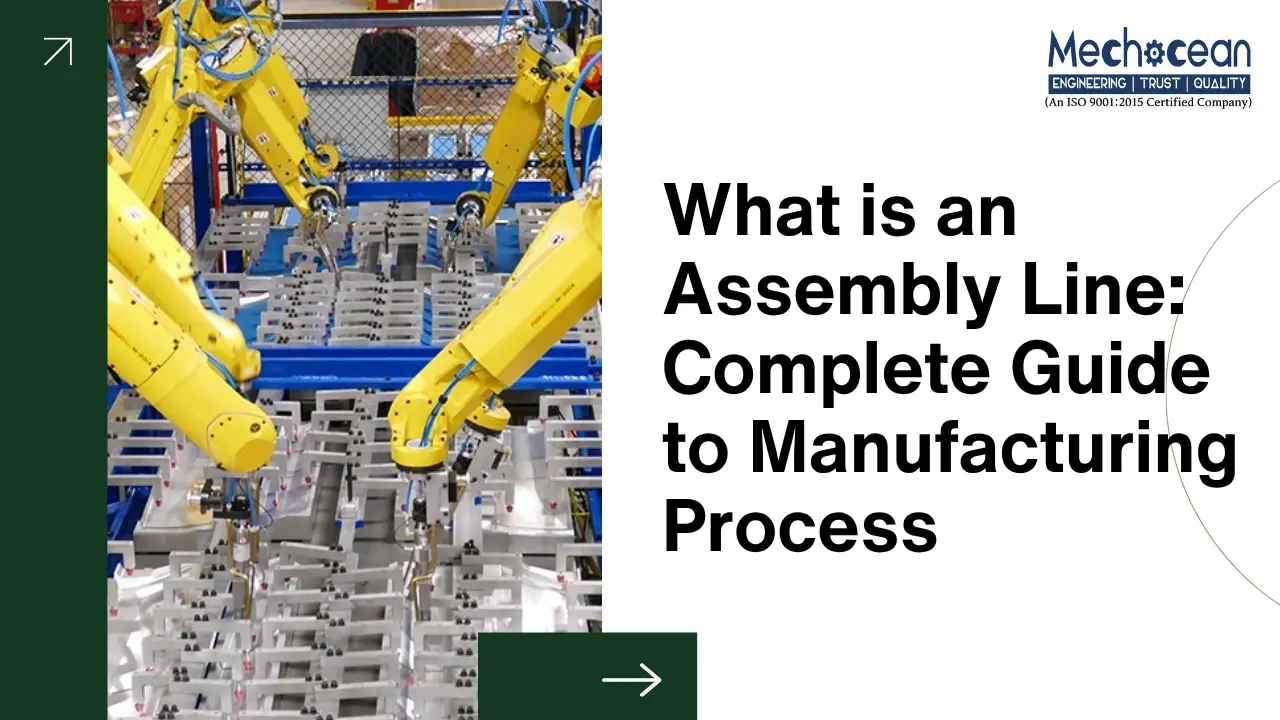
- Automated Assembly Line- Machines and robots perform most of the tasks. Ideal for large-scale production.
- Semi-Automatic Assembly Line- Combination of human effort and machines. Offers flexibility and efficiency.
Advantages of Assembly Line
The assembly line system offers many benefits:
- Faster Production- Products are manufactured quickly due to continuous workflow.
- Cost Effective- Reduced labor cost and better resource utilization.
- Consistent Quality- Standard processes ensure uniform output.
- Easy Training- Workers only need to learn one task, making training simple.
- Increased Output- Industries can produce more products in less time.
Disadvantages of Assembly Line
While assembly lines are very useful, there are some limitations:
- Repetitive work can become boring for workers
- Initial setup cost can be high
- A breakdown at one station can stop the entire line
However, with proper management and maintenance, these challenges can be minimized.
Assembly Line in Modern Manufacturing
Today, assembly lines are more advanced than ever. With the use of automation, robotics, and smart technologies, industries are achieving higher efficiency and precision.
Companies like MECHOCEAN MACHINES INDIA PVT. LTD. are contributing to this transformation by providing modern machinery and solutions that improve manufacturing processes.
Advanced assembly lines now include:
- Sensors for quality control
- Automated conveyors
- Real-time monitoring systems
These innovations make production smarter and more reliable.
Real-Life Example of Assembly Line
A simple example of an assembly line can be seen in mobile phone manufacturing:
- One station assembles the screen
- Another installs the battery
- Next adds internal components
- Final station checks quality and packs the product
This step-by-step process ensures fast and efficient production.
Why Assembly Lines are Important for Industries?
The assembly line plays a crucial role in industrial growth. It helps businesses:
- Meet high market demand
- Maintain product quality
- Reduce production cost
- Improve overall productivity
Without assembly lines, mass production would be slow and expensive.
Conclusion
To sum up, understanding what an assembly line is important for anyone involved in manufacturing or industrial processes. It is a powerful system that has changed the way products are made across the world.
From its simple assembly line definition to its practical benefits, this method helps industries achieve speed, efficiency, and quality. The answer to what purpose does the assembly line serve is clear — it simplifies production and boosts output.
With key assembly line characteristics like continuous flow, division of work, and standardization, it remains one of the most effective manufacturing methods even today. If you are looking to improve your production system, investing in a well-designed assembly line can be a smart and profitable decision.