Hydraulic cylinders are among the most important components used in industrial machinery, construction equipment, agricultural machines, and manufacturing systems. They provide the powerful linear force required to lift, push, pull, or move heavy loads with precision and efficiency. From excavators and loaders to hydraulic presses and material handling systems, hydraulic cylinders play a crucial role in modern industries.
In this article, we will explain what a hydraulic-cylinder is, how does a hydraulic cylinder work, its key components, and why it is widely used across different industrial applications.
What Is a Hydraulic Cylinder?
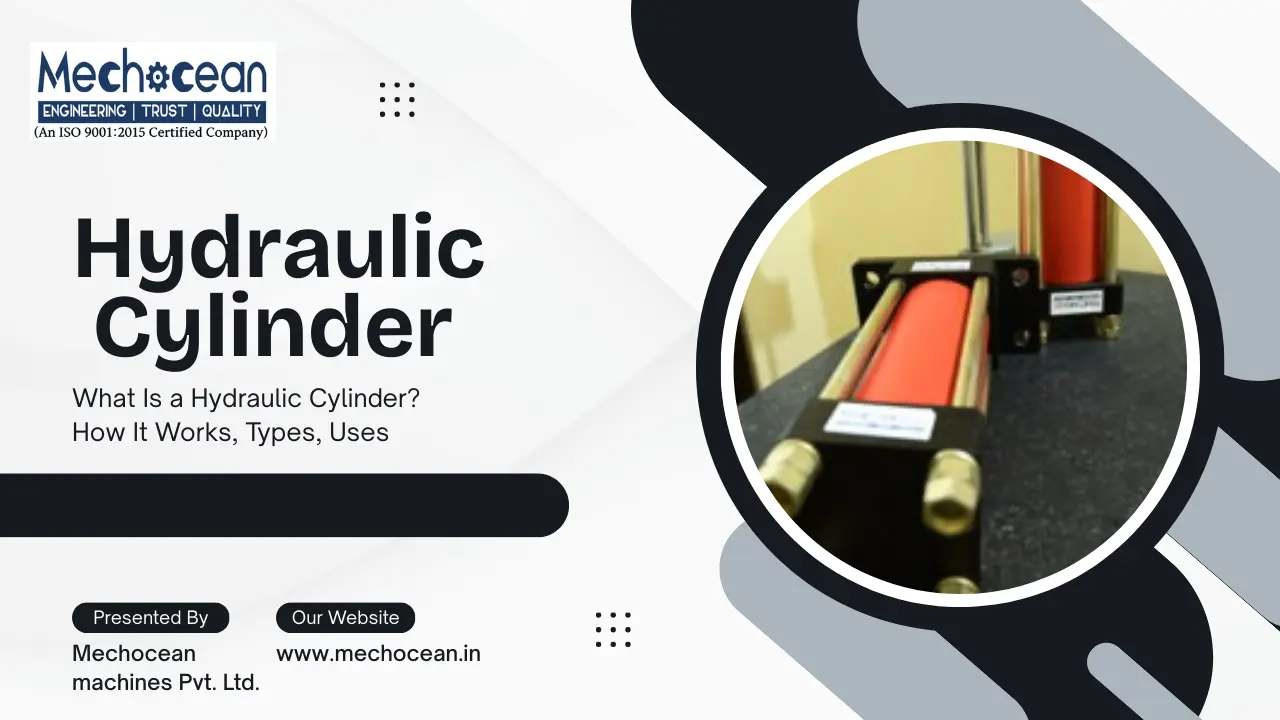
A hydraulic-cylinder is a mechanical actuator that converts hydraulic energy into linear motion and force. It operates by using pressurized hydraulic fluid to move a piston inside a cylinder. This movement generates the force needed to perform various tasks such as lifting heavy equipment, pushing materials, clamping workpieces, or controlling machine movements. Hydraulic-cylinders are known for their high power output, durability, and ability to handle heavy-duty operations in demanding environments.
Read More: Hydraulic Cylinders: Types, Configurations & Applications
How Does a Hydraulic Cylinder Work?
The working principle is based on Pascal’s Law, which states that pressure applied to a confined fluid is transmitted equally in all directions.
Step-by-Step Working Process
- Hydraulic fluid is pumped into the cylinder through an inlet port.
- The pressurized fluid enters the cylinder chamber.
- The pressure pushes the piston forward inside the cylinder.
- As the piston moves, the piston rod extends outward.
- The extending rod creates the linear force required to perform work.
- To retract the rod, hydraulic fluid is directed to the opposite side of the piston.
- The piston moves back, and the rod returns to its original position.
This simple yet highly effective mechanism answers the common question: how does a hydraulic cylinder work in industrial machinery.
Common Hydraulic Cylinder Maintenance Tips
To maximize performance and lifespan:
- Regularly inspect seals for wear.
- Check hydraulic fluid levels and quality.
- Keep the cylinder rod clean.
- Monitor for leaks and unusual noises.
- Inspect mounting points and connections.
- Follow the manufacturer’s maintenance schedule.
Routine maintenance helps prevent unexpected downtime and costly repairs.
Choosing the Right Hydraulic Cylinder
When selecting a hydraulic cylinder, consider:
- Load capacity
- Operating pressure
- Stroke length
- Mounting configuration
- Environmental conditions
- Speed requirements
- Cylinder material and finish
Choosing the correct cylinder ensures optimal performance and operational efficiency.
Conclusion
A hydraulic cylinder is a powerful device that converts hydraulic pressure into linear motion and force. Understanding how do hydraulic cylinders work, their internal structure, and the various hydraulic cylinder components can help businesses select the right solution for their applications. From the hydraulic cylinder barrel to the piston rod and seals, all parts of a hydraulic cylinder work together to deliver reliable and efficient performance.
Whether used in construction, manufacturing, agriculture, or industrial automation, hydraulic cylinders remain one of the most effective solutions for handling heavy loads and achieving precise motion control.