In modern industries, machines are expected to perform heavy-duty tasks with accuracy, safety, and consistency. Whether it is lifting massive loads, pressing metal sheets, or moving equipment smoothly, hydraulic systems play a key role. One of the most important components of these systems is the hydraulic cylinder.
MECHOCEAN MACHINES INDIA PVT. LTD. is a reliable manufacturer & supplier of hydraulic cylinders. We provide high-performance hydraulic equipment designed to meet demanding industrial applications. In this blog, we will clearly explain what a hydraulic cylinder is, its working principle, how it functions, different types, and where it is used.
What Is a Hydraulic Cylinder?
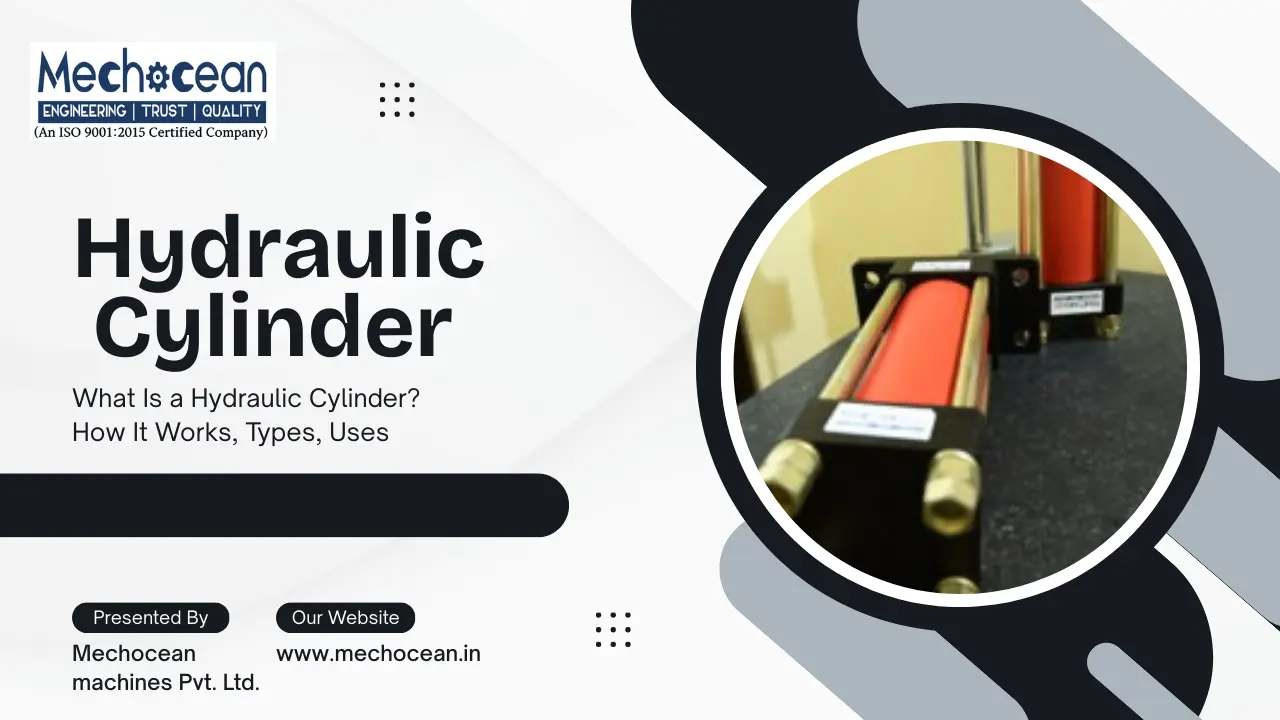
A hydraulic cylinder is a mechanical device that converts hydraulic pressure into linear motion. It uses pressurized hydraulic oil to generate force and movement in a straight line. This makes hydraulic cylinders ideal for applications where pushing, pulling, lifting, or pressing heavy loads is required.
Unlike electric motors that create rotary motion, a hydraulic cylinder produces controlled linear movement. Because of this ability to generate very high force in a compact size, hydraulic cylinders are widely used in industrial machinery, construction equipment, and material handling systems.
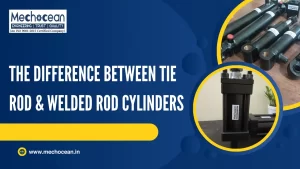
Also Read: The Difference Between Tie Rod & Welded Rod Cylinders
Hydraulic-Cylinder Function in Machines
The primary hydraulic cylinder function is to transmit power by converting fluid energy into mechanical energy. This allows machines to perform tasks that require strength, stability, and precision. In real applications, hydraulic-cylinders are used to lift heavy components, move machine parts, apply pressure during forming processes, and hold loads in position. Their ability to work smoothly under high load conditions makes them essential in heavy engineering industries.
Hydraulic-Cylinder Working Principle Explained
To understand the hydraulic cylinder working principle, it is important to know the basic concept behind hydraulics. Hydraulic systems operate on Pascal’s Law, which states that pressure applied to a confined fluid is transmitted equally in all directions.
When hydraulic oil is pumped into the cylinder, it applies pressure on the piston surface. This pressure creates force, which moves the piston and piston rod. The force generated depends on the oil pressure and the surface area of the piston. This is the core principle behind hydraulic cylinder working.
How Does a Hydraulic-Cylinder Work?
Many people often ask, how does a hydraulic cylinder work? The process is quite straightforward. Pressurized hydraulic oil enters the cylinder through a port and pushes against the piston. As the pressure builds up, the piston begins to move inside the cylinder barrel. This movement extends or retracts the piston rod, depending on the direction of oil flow.
This movement is then transferred to the machine component connected to the piston rod. In this way, hydraulic energy is converted into useful mechanical work. This explains clearly how do hydraulic-cylinders work in different machines.
Working of Hydraulic-Cylinder in Simple Terms
The working of hydraulic cylinder can be understood by observing how oil flow direction controls motion. When oil enters one side of the piston, the rod moves outward. When oil is redirected to the opposite side, the rod moves back.
This controlled extension and retraction allow machines to perform precise operations. Whether it is lifting a load or pressing a workpiece, the hydraulic cylinder ensures smooth and powerful movement.
How Hydraulic Cylinders Work in Real Applications?
To understand how hydraulic cylinders work in practical situations, consider a hydraulic press. When oil enters the cylinder, pressure builds up and the piston moves downward. This movement applies force on the material placed below, allowing it to be pressed or shaped.
The same principle applies to excavators, forklifts, cranes, and industrial presses. In each case, the hydraulic cylinder converts oil pressure into mechanical force, making heavy work easier and safer.
Main Components and How a Hydraulic Piston Works
A hydraulic cylinder consists of several internal components working together. The piston plays a very important role in this system. Many users ask, how does a hydraulic piston work?
The piston is fitted tightly inside the cylinder barrel. When pressurized oil acts on the piston surface, it creates force that moves the piston forward or backward. The piston rod attached to it transfers this movement to the machine. Proper sealing around the piston ensures that pressure is maintained and leakage is prevented.
Types of Hydraulic-Cylinders
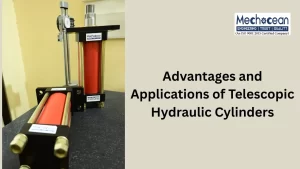
Hydraulic-cylinders are designed in different types to suit various industrial needs. Some cylinders are designed for simple lifting tasks, while others are made for complex and continuous operations. Single-acting hydraulic cylinders use hydraulic pressure in one direction only, with the return movement achieved through gravity or spring force. Double-acting hydraulic cylinders, on the other hand, use pressure for both extension and retraction, offering better control and efficiency. Tie-rod cylinders are commonly used in industrial machinery due to their easy maintenance, while welded cylinders are compact and preferred in mobile equipment. Telescopic cylinders are used where long strokes are required within limited space.
Uses of Hydraulic Cylinders Across Industries
Hydraulic-cylinders are used in almost every heavy industry today. In manufacturing units, they are found in press machines, molding machines, and automation systems. In construction, they power excavators, loaders, and cranes. Material handling equipment such as forklifts and lifting platforms also rely heavily on hydraulic cylinders. These wide-ranging applications clearly show how a hydraulic cylinder works to improve efficiency, safety, and productivity.
Advantages of Hydraulic Cylinders
One of the main reasons industries prefer hydraulic-cylinders is their ability to generate high force with smooth control. They are compact, reliable, and capable of operating under extreme load conditions. Hydraulic cylinders also offer long service life when designed and maintained properly.
Their consistent performance makes them suitable for continuous industrial operations.
Why Choose MECHOCEAN MACHINES INDIA PVT. LTD.?
At MECHOCEAN MACHINES INDIA PVT. LTD., we focus on engineering excellence and quality manufacturing. Our hydraulic-cylinders are designed to deliver reliable performance in demanding environments. We use high-grade materials, precision machining, and advanced sealing systems to ensure durability and efficiency. Our solutions are tailored to meet specific application requirements, making us a trusted partner for industrial hydraulic systems.
Conclusion
Now you have a clear understanding of what is a hydraulic cylinder, its working principle, and real-world applications. By learning how does a hydraulic-cylinder work, how hydraulic-cylinders work, and the complete working of hydraulic-cylinder, it becomes easier to choose the right solution for industrial needs. With strong design, dependable performance, and proven expertise, MECHOCEAN MACHINES INDIA PVT. LTD. continues to support industries with high-quality hydraulic-cylinder solutions.